



Finding Trauma Therapy for First Responders in Chicago
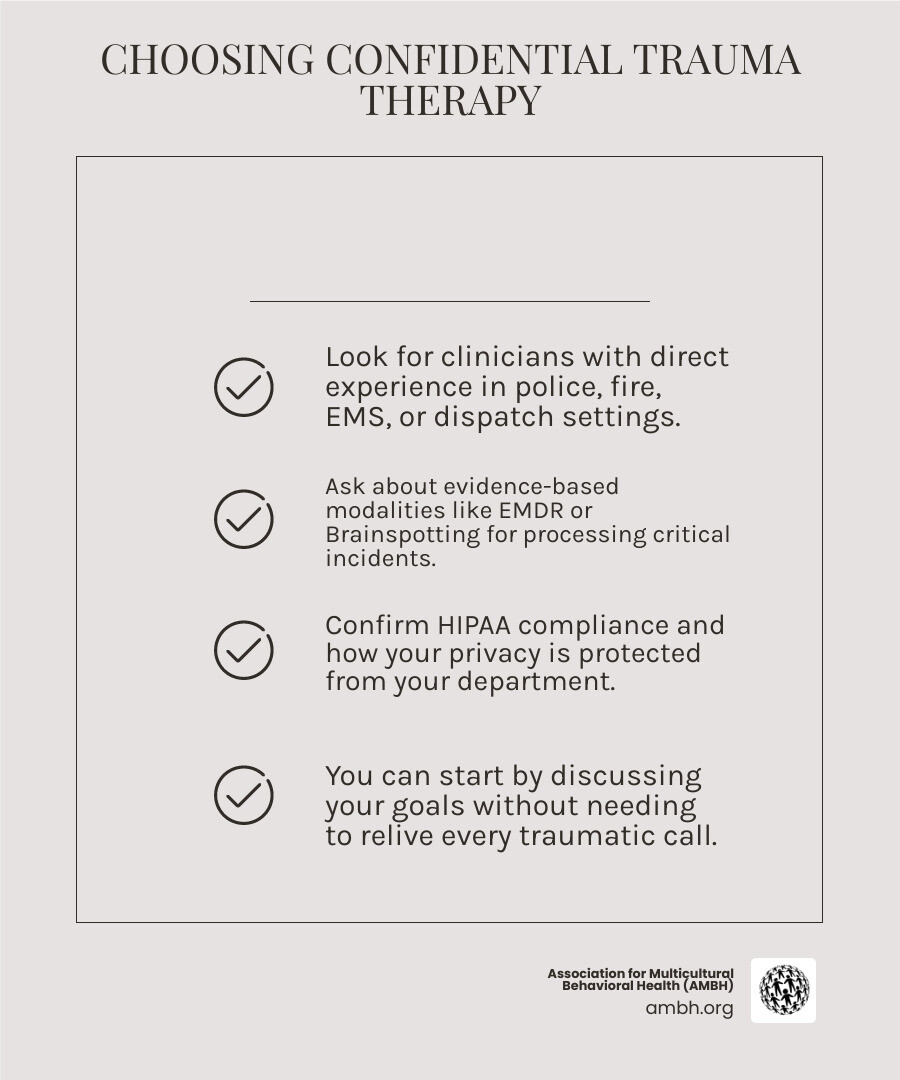
First responders in Chicago can seek outpatient trauma therapy with a clinician who understands public safety work. Ask about experience with police, fire, EMS, or dispatch; options such as EMDR or Brainspotting; and how privacy works before you book. In a first session, you can discuss what has been happening, what support you want, and whether the therapist is a good fit. You do not need to describe every difficult call at once. Consult a licensed mental health professional for an individual assessment and guidance about treatment options. AMBH does not prescribe medication.
The Association for Multicultural Behavioral Health (AMBH) offers trauma therapy for first responders in Chicago at its Edison Park office and through telehealth for clients across Illinois. Support can address the effects of repeated crises on sleep, mood, and relationships.
AMBH was founded by Angelika Danek, LCSW, CRADC, our founder and clinical director. Our team offers trauma therapy for first responders with an approach that recognizes the demands of public safety work.
Understanding the Impact of Cumulative Stress and Trauma on Public Safety Personnel

Police officers, firefighters, paramedics, emergency medical technicians (EMTs), 911 dispatchers, and correctional officers may face repeated exposure to emergencies, violence, injury, and loss.
First responders may encounter critical incidents repeatedly over their careers. Repeated exposure to crises can contribute to cumulative stress.
After repeated high-pressure situations, some first responders may continue to feel on alert even when an emergency is over. This can make it difficult to relax outside work.
First responders may also seek support for guilt, moral injury (distress related to events that conflict with deeply held values), grief, and distress related to exposure to others’ suffering.
If you are in crisis, call or text 988 (Suicide & Crisis Lifeline) or call 911 in an emergency.
How Daily Operational Hazards and Critical Incidents Manifest in Daily Life
The physical and psychological toll of public safety work rarely stays at the station or inside the patrol vehicle. Repeated occupational stress may affect physical health, emotions, and relationships. Concerns people may discuss with a therapist include:
- Sleep Disturbance and Nightmares: Trouble falling asleep, waking up startled at slight noises, or experiencing vivid dreams related to past calls.
- Hypervigilance and Inability to Decompress: Feeling constantly on alert or having difficulty relaxing after work.
- Emotional Reactivity and Irritability: Anger, irritability, or guilt.
- Emotional Numbing and Detachment: Feeling disconnected from loved ones, losing interest in hobbies, or feeling like you are simply “going through the motions.”
- Intrusive Memories and Flashbacks: Unwanted visual, auditory, or sensory reminders of distressing calls intruding during quiet moments.
- Burnout and Compassion Fatigue: A deep sense of emotional exhaustion, cynicism toward the public, and feeling depleted of empathy.
- Physical Tension: Stress may be experienced as bodily tension or difficulty relaxing.
Why Public Safety Culture Demands Specialized Trauma Therapy for First Responders
AMBH recognizes the importance of privacy, trust, service, and resilience in public safety work. Seeking support for emotional exhaustion or traumatic stress does not mean weakness.
When choosing a therapist, ask about their experience with public safety work and whether their approach respects your privacy, work demands, and comfort level.
Our specialized first responder services are designed to respect these cultural values while offering practical tools to support trauma processing at a pace tailored to each client.
Evidence-Based Modalities in Trauma Therapy for First Responders
Trauma treatment is tailored to each person’s needs and may include talk therapy, EMDR, Brainspotting, or somatic approaches.
At AMBH, we offer evidence-based trauma therapy that may help clients process distressing experiences and develop a greater sense of emotional balance.
EMDR and Brainspotting for Processing High-Stress Critical Incidents
Eye Movement Desensitization and Reprocessing (EMDR) and Brainspotting are two approaches AMBH may use in trauma therapy:
- Eye Movement Desensitization and Reprocessing (EMDR): EMDR utilizes bilateral stimulation (such as side-to-side eye movements, alternating auditory tones, or gentle hand taps) while you briefly hold a traumatic image in mind. The goal is to help distressing memories become less overwhelming over time. A significant advantage for first responders is that EMDR does not require you to describe every graphic detail out loud to process the memory effectively.
- Brainspotting: In Brainspotting, a therapist helps you identify an eye position that appears connected to emotional distress or body-based tension. Focusing on that position in a supportive setting may help you explore and process difficult experiences.

Somatic Regulation and Nervous System Recovery Techniques
Stress and trauma may be experienced through physical tension, restlessness, changes in breathing, or difficulty relaxing. Somatic therapy focuses on these connections between emotional experiences and bodily sensations.
Somatic interventions use body awareness and related practices to support emotional regulation and relaxation. Through somatic therapy approaches, clinicians teach practical grounding, breath regulation, and sensory awareness techniques that can be used between calls, in the station bunk room, or at home.
Therapy may help you develop ways to relax after work, support sleep routines, and feel more present in daily life.
Addressing Stigma and Questions About Confidentiality
First responders considering mental health care may have questions about confidentiality: Will my department find out? Will this impact my badge, my FOID card, or my promotional path?
AMBH offers confidential outpatient therapy for first responders. Before starting, ask our team how privacy, consent, record access, and any required disclosures are handled, including whether any information could be shared with an employer.
Questions to Ask About Privacy
Ask who can access your records and whether an agency-sponsored program has any attendance or reporting requirements.
Ask the clinician to explain any limits to confidentiality before you share sensitive information. For questions about legal rights or employment consequences, consult an attorney.
Proactive Wellness Checks vs. Fitness-for-Duty Evaluations
Our wellness checks are preventive and supportive, not fitness-for-duty evaluations. Ask about the purpose and privacy arrangements of any employer-related appointment before participating.
Our mental health wellness checks are confidential, preventive, and supportive, and may assist agencies seeking to support officer wellness consistent with Illinois SAFE-T Act / Public Act 101-652 requirements.
| Feature | Proactive Mental Health Wellness Check | Fitness-for-Duty Evaluation |
|---|---|---|
| Purpose | Preventative wellness, stress mitigation, and resilience building | Ask whether the evaluation assesses capacity to perform job duties |
| Initiation | May be part of a proactive agency wellness program; ask whether participation is required. | Ask who requested the evaluation and whether participation is required |
| Privacy questions | Ask about confidentiality limits and whether attendance or other information is reported | Ask what findings will be shared, with whom, and for what purpose |
| Clinician Role | Supportive counselor focused on your personal well-being | Ask about the evaluator’s role and relationship to the employer |
| Outcome | Discussion of coping strategies, stress regulation, and whether additional support may help | Ask whether a duty-status recommendation will be made and who will receive it |
A proactive wellness check is a supportive conversation about your stress levels, sleep, and overall wellness. Its purpose is to support well-being, identify stress early, and connect you with additional support when needed. Ask about privacy arrangements before participating.
Comprehensive Support for First Responders and Their Families in Chicago
Occupational trauma does not affect first responders in isolation. Work-related stress may also affect relationships and family life.
First responders and their family members may seek support for relationship stress, sleep difficulties, irritability, or emotional disconnection.
Navigating Family Dynamics and Secondary Traumatic Stress in Public Safety Households
When public safety professionals spend an entire shift managing life-and-death crises, coming home to everyday domestic challenges—like a messy kitchen or children squabbling—can feel jarring. Some first responders may have difficulty relaxing or feeling emotionally present outside work.
Through individual and family psychotherapy, couples and families may work toward these goals:
- Understand stress responses and ways to relax after a shift.
- Improve communication without requiring the first responder to share graphic details of traumatic calls.
- Address secondary traumatic stress experienced by partners and children.
- Rebuild emotional intimacy, mutual trust, and shared presence at home.
Finding Confidential Trauma Therapy for First Responders for You and Your Loved Ones
Finding the right clinician in the Chicagoland area involves choosing a practice that combines clinical trauma expertise with an authentic understanding of public safety culture.
At the Association for Multicultural Behavioral Health (AMBH), our outpatient psychotherapy team provides specialized care in a private setting. Located in Edison Park on Chicago’s Northwest Side (6650 N. Northwest Highway, Suite 215), we serve first responders across Chicago and surrounding communities. We also offer telehealth sessions for clients located anywhere in Illinois.
Our multilingual and multicultural team provides therapy in English, Polish, Spanish, Russian, and Arabic. Service availability varies by language; ask our team which clinician is the best fit for you. We accept most major health insurance plans, including Blue Cross Blue Shield (BCBS), Aetna, Cigna, Humana, UnitedHealthcare/Optum, Medicare (including Advantage PPO), and TRICARE (Medicaid is not accepted). For those seeking private pay, individual therapy sessions start at $150, couples sessions start at $180, and group therapy is $45 per hour, and reduced fee may be available case by case.
Frequently Asked Questions About Trauma Therapy for First Responders
What is the difference between a mental health wellness check and a fitness-for-duty evaluation?
A mental health wellness check is a confidential, preventative conversation with a licensed therapist focused on your personal well-being, stress levels, and resilience. Ask the clinician about confidentiality limits and any agency reporting arrangements before participating. AMBH’s wellness checks are not fitness-for-duty evaluations. For any employer-related evaluation, ask about its purpose, whether participation is required, and what findings will be reported to the agency.
How does EMDR help first responders process traumatic calls without reliving every detail?
EMDR works by using bilateral stimulation (such as horizontal eye movements or gentle alternating taps) to help your brain reprocess stuck, distressing memories. EMDR does not require you to describe every graphic detail aloud. A therapist can explain the process and help determine whether it fits your needs.
What should I ask about confidentiality before starting therapy?
AMBH offers confidential outpatient therapy for first responders. Ask our team to explain consent, access to records, limits to confidentiality, and any reporting arrangements connected with an employer-sponsored program. Consult an attorney for advice about legal rights or employment consequences.
Conclusion
Public safety professionals spend their careers showing up for others on their worst days. Recognizing the effects of repeated crisis calls and work-related stress can help you identify concerns to discuss with a therapist.
Trauma therapy can be tailored to your needs, values, and goals. It may help you develop ways to relax when the shift ends, feel more grounded at home, and manage work-related stress.
If you are a police officer, firefighter, paramedic, EMT, dispatcher, or corrections officer in Chicago or across Illinois seeking confidential, trauma-informed care, our team is here to support you. Contact our team today or call us directly at (773) 313-3757 to discuss our first responder services and take a proactive step toward your well-being.