



How Cultural Family Counseling Helps Families Feel Heard
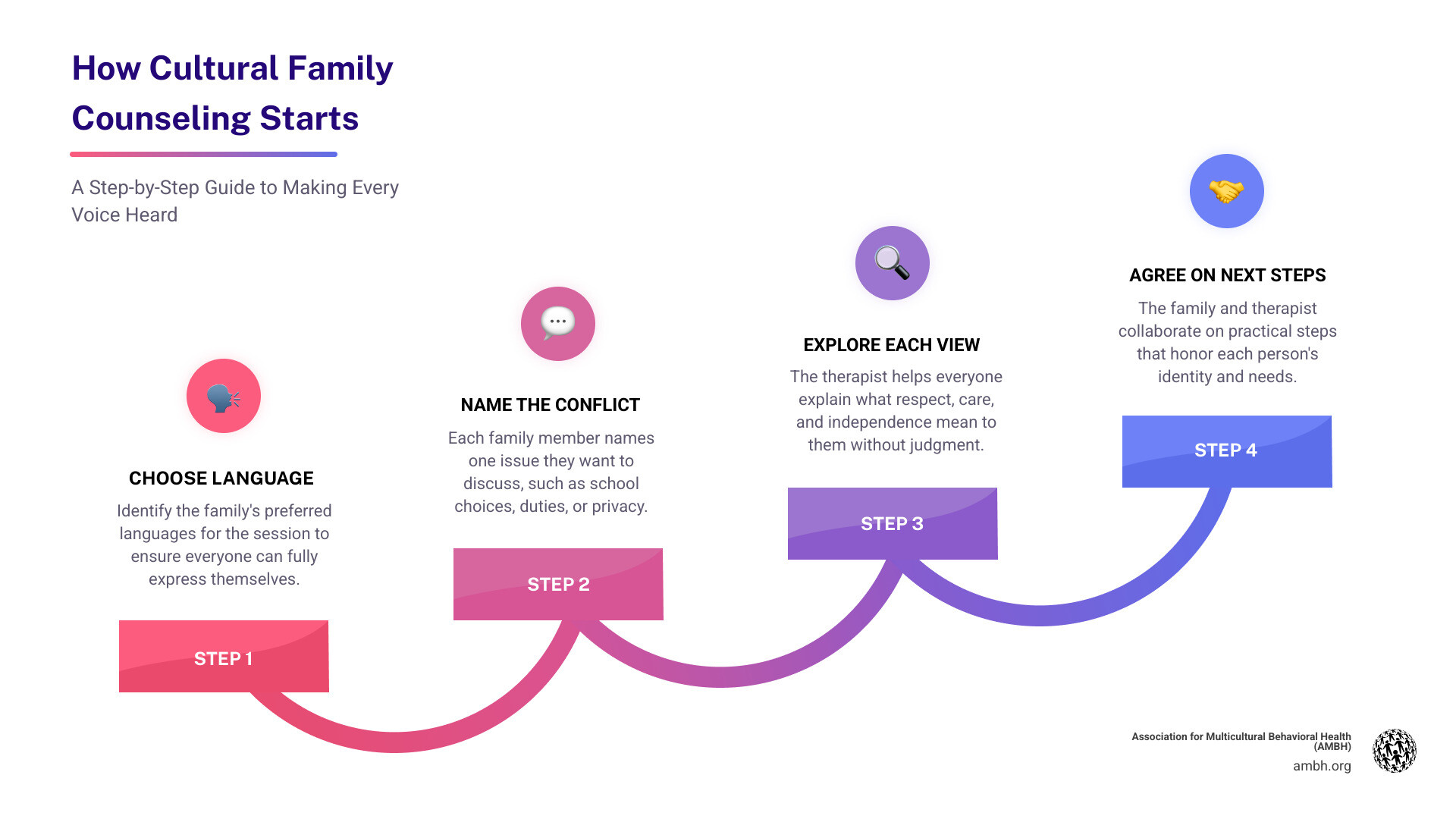
Cultural family counseling helps families work through conflict without asking anyone to set aside their identity. If you are looking for a therapist, ask whether they can speak your family’s preferred languages and how they make room for each person’s views. A good first step is to name one issue you want to discuss, such as school choices, family duties, or privacy at home. The therapist can then help your family understand what each person means by respect, care, and independence.
This matters when parents and children have grown up with different expectations. A conversation about boundaries, for example, may also be a conversation about love, safety, or responsibility.
At the Association for Multicultural Behavioral Health (AMBH), our team is led by Angelika Danek, LCSW, CRADC, Founder and Clinical Director. Our clinicians bring experience in mental health and addiction treatment to cultural family counseling, including support for immigrant families and bilingual children of Polish parents.
Understanding Intergenerational and Acculturation Gaps in Immigrant Households
Living in a cross-cultural household often means living across different timelines of adaptation. We consider how your family’s values and behaviors may differ across settings. While children often adapt quickly to the cultural norms, social cues, and communication styles of mainstream Western society, parents may maintain traditional values and practices rooted in their country of origin.
This differential pace of adaptation does not indicate a lack of love; rather, it creates an environment where basic household expectations are interpreted through entirely different lenses. For parents, maintaining cultural traditions offers continuity, security, and a protective buffer against minority stress. For children, fitting in with peers and adopting individualistic social norms feels necessary for daily belonging and academic survival.
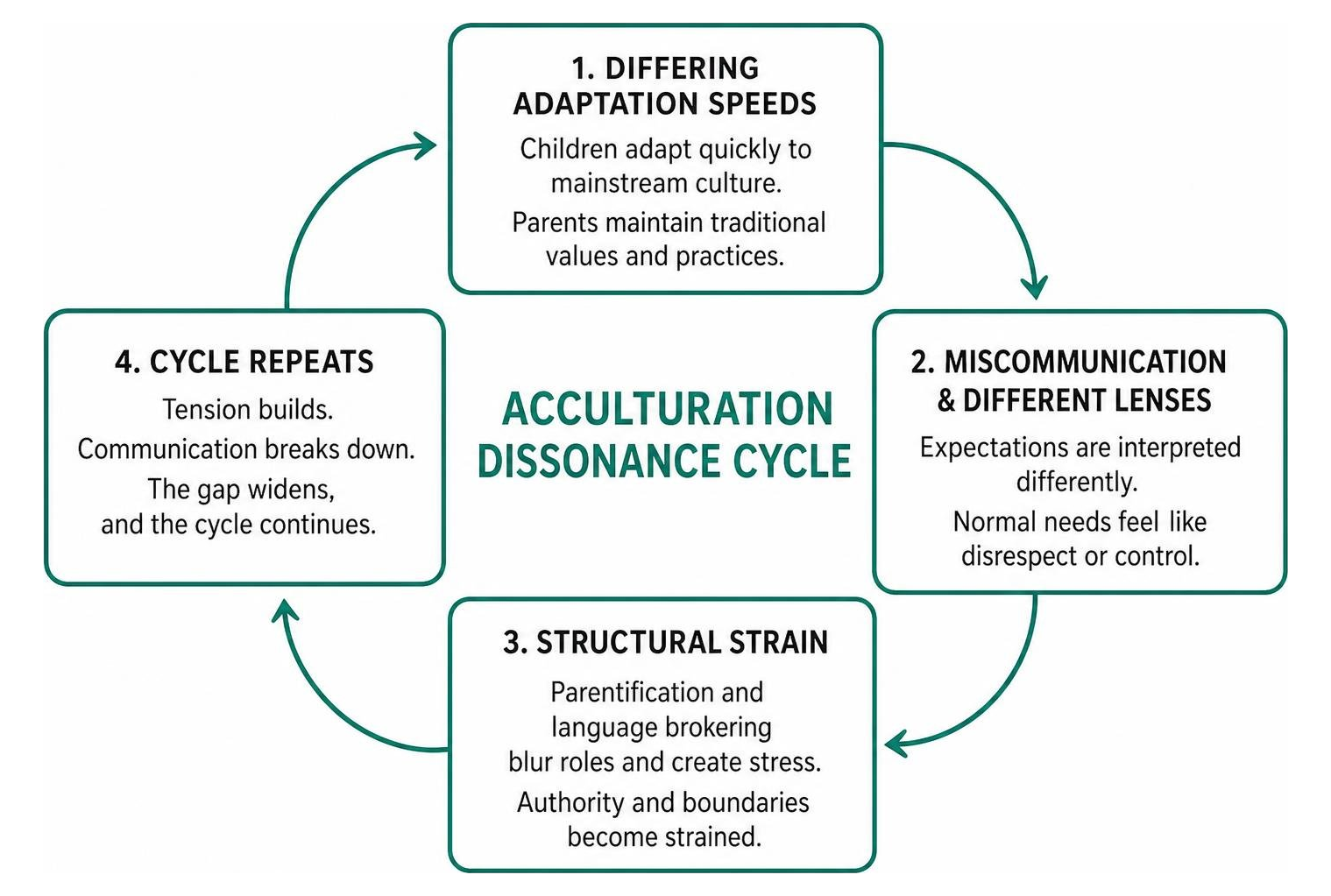
When family members lack a shared framework for these differences, normal developmental milestones can turn into prolonged relational standoffs. A teenager asking for privacy or seeking independence may be perceived by parents as disrespectful, rebellious, or rejecting family heritage. Conversely, parents attempting to protect and guide their youth may be seen as rigid, overly controlling, or intrusive.
In many immigrant homes, these differences can also involve parentification, when children take on adult responsibilities, and language brokering, when they interpret between languages for family members. Children who gain English fluency faster than their parents may be asked to translate legal documents, schedule medical appointments, or speak with school administrators. While these responsibilities can foster resilience, maturity, and pride, they can also place stressful demands on children and complicate family roles. We make room to discuss both the contributions children value and the responsibilities that feel too heavy.
Cultural Values: Collectivism, Family Duty, and Respect for Elders
Many Polish, Latin American, Middle Eastern and Russian-speaking families share collectivist values: the family, not the individual alone, is the main source of identity, and respect for parents and elders is central. Parents often show love through sacrifice, hard work, close involvement and practical care. In a U.S. setting, this high involvement and firm guidance can be misread as simply strict or controlling, while for the family it is an expression of care and responsibility.
Navigating Intergenerational Conflicts Around Education, Marriage, and Autonomy
Intergenerational conflict in immigrant households often crystallizes around three pivotal areas: academic achievement, dating or marriage, and career choices. In collectivist families, academic effort and career success are not merely personal achievements; they represent family pride, collective mobility, and repayment for parental sacrifice.
When a young person wishes to pursue a creative field, take time off before college, or establish romantic relationships outside their community, it can trigger intense anxiety for parents. Immigrant parents may fear that their child is abandoning the safety nets that ensure long-term survival in a competitive society.
When these generational pressures become overwhelming, specialized child and adolescent therapy can offer young people a safe environment to process academic stress, identity confusion, and family obligations while honoring their parents’ sacrifices.
Core Frameworks of Cultural Family Counseling
We consider each family’s cultural context when discussing family therapy (Roy et al., 2017). Rather than labeling non-Western family structures as dysfunctional, we recognize that what is considered healthy communication or structure is deeply tied to cultural context.
In counseling, we can draw on tools such as the cultural genogram, a family diagram that can map immigration histories, religious traditions, language proficiencies, and changes in family roles across generations. Understanding a family’s stage of life and experiences of cultural adaptation can help us consider changes that respect its core values. A qualitative study of clinicians working with families in South India identified cultural competence and attention to families’ cultural beliefs as important considerations in family therapy.
Adapting Structural Family Therapy in Cultural Family Counseling
Structural Family Therapy (SFT), originally developed by Salvador Minuchin, is a framework used in family psychotherapy. When considering this framework with immigrant households, we consider how its concepts fit each family’s values and circumstances.
A central adaptation involves re-evaluating the concept of enmeshment. Enmeshment refers to boundaries that are so blurred that individual needs and autonomy are difficult to maintain. We distinguish these difficulties from culturally valued closeness, mutual support, and interdependence rather than treating closeness itself as a problem.
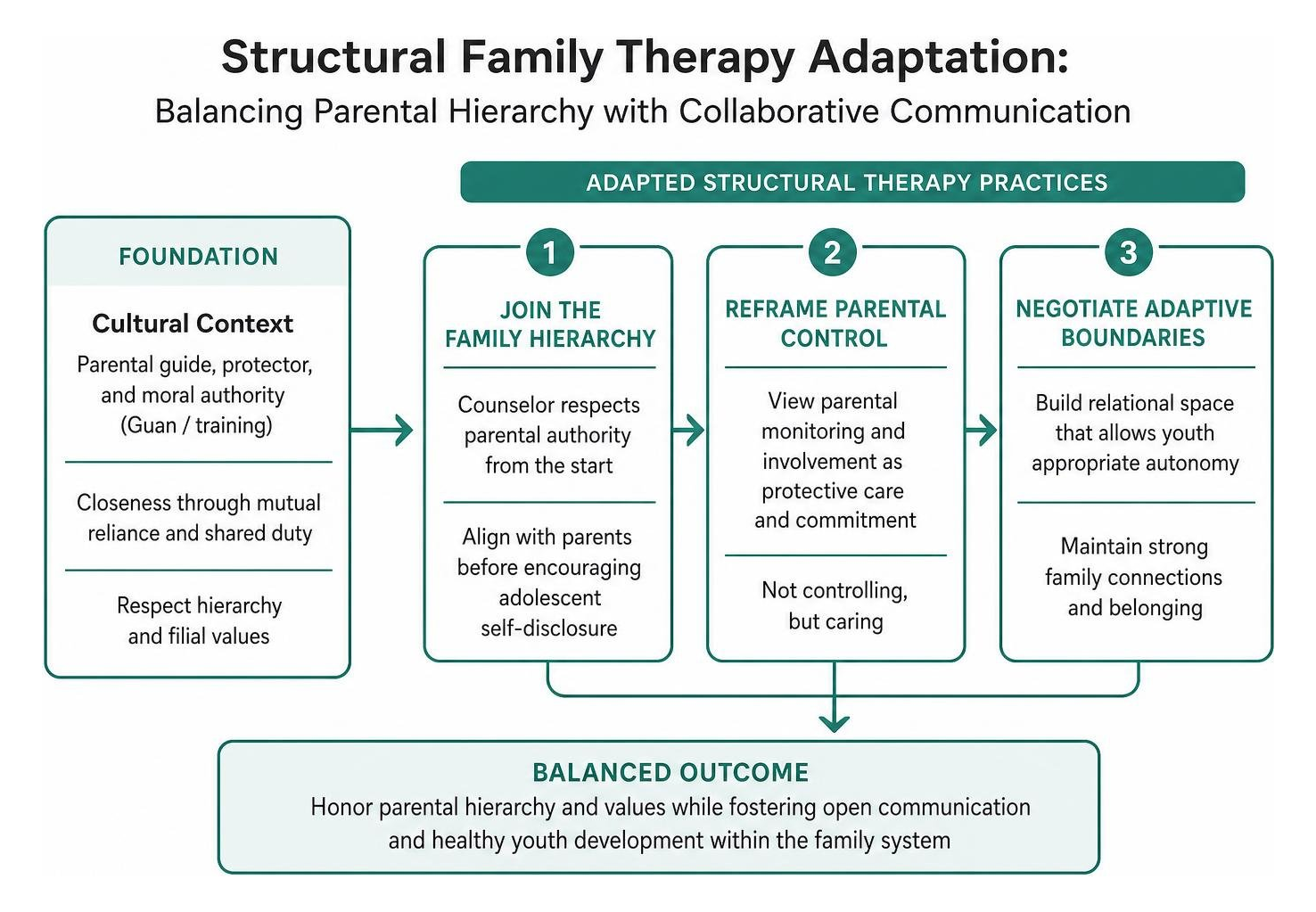
Culturally adapted structural therapy focuses on:
- Respecting Family Roles: We explore parental authority and each family member’s role while making room for both parents’ and young people’s perspectives.
- Exploring Parental Monitoring: We explore what parental monitoring means to each family member rather than assuming it represents either control or protective care.
- Negotiating Adaptive Boundaries: Rather than pushing for strict personal independence, we help the family build relational space that allows the youth appropriate autonomy while keeping family connections intact.
- Modifying Enactments: When family members practice interactions in a session, we use gentle, structured communication rather than direct confrontation, with the aim of preserving each person’s dignity.
Building Alliances and Protecting Dignity in Cultural Family Counseling
In many immigrant communities, mental health struggles carry significant social stigma. The concept of saving face—preserving family dignity and preventing public shame—can cause families to delay seeking help until problems become severe. Many families reach out only when internal stress outweighs the fear of outside judgment.
To build a trusting working relationship with your family, we practice cultural humility:
- Validating Physical Expressions of Distress: We take physical experiences such as headaches, stomach tension, or fatigue seriously rather than dismissing them as avoidance or assuming what causes them.
- Recognizing Strengths: We identify family resilience, skills used to navigate migration, and mutual care alongside the concerns that brought the family to therapy.
- Normalizing Difficulties: We explore how navigating different cultural expectations may contribute to family concerns. This may help reduce self-blame and make it easier to engage in therapy.
We provide outpatient mental health services. We do not prescribe medication. Always speak with a licensed professional regarding specific medical or diagnostic questions. If you are in crisis, call or text 988 (Suicide & Crisis Lifeline) or call 911 in an emergency.
Restructuring Boundaries While Honoring Extended Family Systems
In Western nuclear family models, boundaries are drawn tightly around the parents and children. However, in many immigrant and collectivist households, the family system naturally includes grandparents, aunts, uncles, and community elders.

Multigenerational living offers rich emotional support, financial resilience, and built-in childcare. However, it can also complicate family boundaries when grandparents hold significant authority over parenting decisions, diet, discipline, and daily routines. When generational lines blur, parents can feel caught between honoring their own parents and responding to the modern needs of their children.
Couples navigating these multi-tiered expectations often benefit from dedicated marriage and couples therapy, which helps partners build a united parenting team while remaining respectful of extended family contributions.
Integrating Extended Kinship Networks in Clinical Practice
Rather than treating extended family members as obstacles to healthy functioning, culturally informed counseling recognizes them as essential resources. We explore each family’s support networks and whether involving extended relatives could be helpful.
When grandparents are actively involved in daily household care, we can discuss whether inviting them into the therapy process—either in person or through structured consultation—would be helpful. We help clarify caregiving roles while respecting the grandparents’ place as elders.
Overcoming Clinical Pitfalls: Cultural Humility vs. Stereotyping
A central challenge in cultural family counseling is balancing knowledge of cultural norms with the danger of stereotyping. No culture is homogeneous. A second-generation family raised in Chicago may hold drastically different values, religious beliefs, and parenting styles than a newly arrived family from a rural region.
We pay attention to within-group differences—the psychological and relational differences that exist within the same broad ethnic community.
We work to avoid assumptions by practicing cultural humility—maintaining an open, curious, and collaborative stance that honors the family as the true experts on their unique lived experience. This includes acknowledging how culture intersects with socioeconomic status, sexual orientation, gender identity, trauma history, and stress related to immigration status.
At the Association for Multicultural Behavioral Health (AMBH), our clinicians bring personal and clinical insights into these complex crossroads. We provide compassionate, outpatient psychotherapy for individuals, couples, and families at our Edison Park, Chicago office and via telehealth for clients located in Illinois. Our multilingual team offers therapy in English, Polish, Spanish, Russian, and Arabic; available services vary by clinician and language.
Frequently Asked Questions About Cultural Family Counseling
How does cultural family counseling differ from standard family therapy?
In cultural family counseling, we consider how family therapy approaches fit your family’s values and circumstances rather than assuming one approach suits everyone. We make room for family duty, respect for elders, indirect communication, and multigenerational decision-making where these matter to your family, with the aim of supporting family relationships while respecting each person’s needs.
How do therapists address language barriers between immigrant parents and English-dominant children?
Our multilingual team considers each family member’s preferred language and the clinician’s language skills when discussing care. We can help family members explore cultural and emotional meanings across languages, with the aim of reducing reliance on children as interpreters and helping parents express emotions in their preferred language while working toward connection with their children.
When should extended family members participate in family sessions?
We can discuss whether inviting extended family members, particularly grandparents who live with the family, would be helpful when they influence parenting, discipline, or household stress. With your family’s agreement, we can explore caregiving roles and parenting differences while respecting family relationships and working toward shared understanding.
Finding Balance and Connection Through Cultural Family Counseling
Navigating a cross-cultural household can feel like balancing between two distinct worlds. Yet, the challenges of acculturation also offer an opportunity to build deep family resilience, shared wisdom, and enduring connection. Cultural family counseling does not require choosing between honoring your heritage and thriving in modern life—it provides a supportive path to embrace both.
At the Association for Multicultural Behavioral Health (AMBH), located in Edison Park, Chicago, our dedicated, multilingual team provides outpatient psychotherapy tailored to the unique values of immigrant and cross-cultural families across Illinois.
To take the first step toward greater understanding and harmony in your home, please contact our multilingual clinicians to schedule an outpatient consultation. We are here to support your family’s journey toward lasting connection.
References
Roy T, Thirumoorthy A, Parthasarathy R. “Culturally Relevant Family Therapy Practice with Parents of Children and Adolescents..” Indian journal of psychological medicine, 2017. PMCID PMC5385740.