



How to Find Supervised Visitation in Chicago
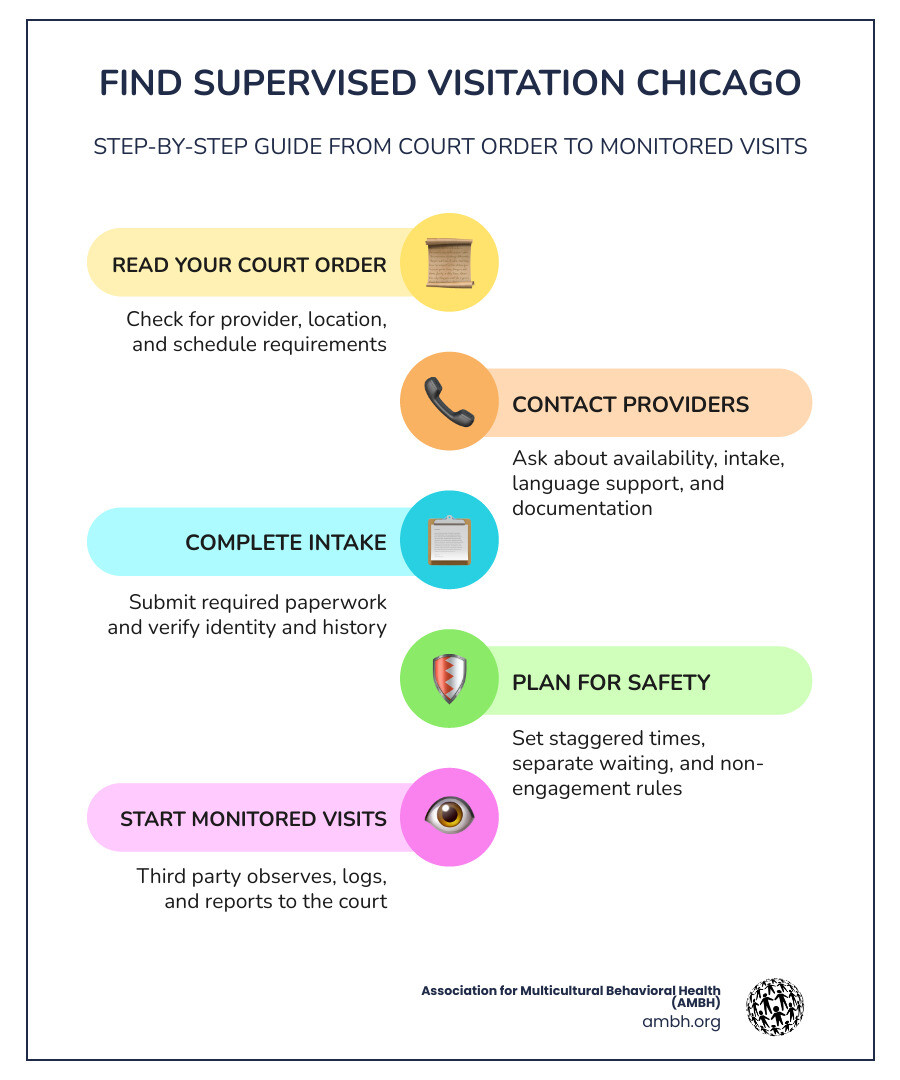
Finding supervised visitation in Chicago lets a parent spend time with their child while a trained third party monitors the visit. If a court has ordered it, start by reading the order for any rules about the provider, location, and schedule. Then contact a provider to ask about availability, intake requirements, language support, and how visits will be documented. A safe exchange is different: it provides a safer handoff between adults but does not monitor the visit itself.
At the Association for Multicultural Behavioral Health (AMBH), founded by Angelika Danek, LCSW, CRADC, our team supports families navigating supervised parenting time during complex family transitions. Angelika serves as our founder and clinical director.
Legal Framework for Supervised Visitation Chicago Families Must Navigate
Navigating the family court system in Cook County can feel overwhelming, especially when parenting time is contested. Ask your attorney how Illinois law applies to your parenting-time order and any proposed supervision.
If supervision is requested, consult your attorney about the evidence and legal standard that apply.
Parents seeking to change an existing parenting-time order should consult their attorney about the legal requirements that apply. Topics to discuss with your attorney include:
- The child’s physical, emotional, and psychological safety.
- The mental and physical health of all individuals involved.
- Any history of domestic violence, physical abuse, or severe interpersonal conflict.
- The willingness of each parent to facilitate a healthy relationship between the child and the other parent.
If you are in crisis, call or text 988 (Suicide & Crisis Lifeline) or call 911 in an emergency.
Requirements for Supervised Visitation Chicago Court Orders Mandate

Ask your attorney what your parenting-time order requires and how any safety concerns affect supervision in your case.
Review your order and ask your attorney or provider about the following:
- The Provider Type: Who is permitted to supervise: a professional center or an agreed-upon neutral supervisor?
- Frequency and Duration: How often may visits occur, and how long may each visit last?
- Financial Responsibility: Who pays the provider fees, and how are costs divided?
- Specific Behavioral Conditions: What rules apply to alcohol or illicit substance use before visits, discussing litigation in front of the child, gifts, and recording devices?
Children processing family restructuring or past household stress frequently benefit from specialized emotional care alongside these legal structures. Accessing supportive child and adolescent therapy helps young individuals navigate anxiety, express their feelings openly, and build healthy coping mechanisms during transitions.
The Relationship Between Independent Providers and the Cook County Judiciary
Ask each provider about its relationship with the Circuit Court of Cook County and how it handles court referrals.
Ask how the provider follows court orders, maintains neutrality, and distinguishes monitoring from legal advocacy, custody evaluation, or investigation. Ask how monitors support physical and emotional safety, observe parent-child interactions, and document their observations.
Contact our team to discuss our supervised parenting time services. Ask the provider what its records include and how requests for records are handled.
Evolution and Infrastructure of Cook County Visitation Services
The landmark federal Violence Against Women Act (VAWA) of 2000 established the Safe Havens: Supervised Visitation and Safe Exchange Grant Program. The program supports supervised visitation and safe exchanges in situations involving domestic violence, child abuse, sexual assault, or stalking.
Chicago participated as a Safe Havens demonstration site, bringing visitation centers, domestic violence advocacy organizations, and courts together to address visitation and exchange in the context of domestic violence.
Chicago’s demonstration project also examined how visitation centers’ design, processes, and procedures accounted for families’ cultural and economic backgrounds.
Safe Exchange Protocols vs. Supervised Parenting Time
Parents often confuse safe exchanges with fully monitored visitation. While both prioritize safety, their execution and purpose differ:
| Feature | Safe Exchange (Monitored Transfer) | Supervised Parenting Time (Monitored Visit) |
|---|---|---|
| Primary Purpose | Facilitate the peaceful handover of a child between parents for unsupervised parenting time. | Provide continuous monitoring of the parent and child throughout their entire time together. |
| Duration | Ask the provider how much time to allow for the handoff. | Ask about session length and any requirements in the court order. |
| Parental Contact | Ask how the provider limits contact between adults during the handoff. | A monitor is present during parent-child contact; ask how arrivals and departures are managed. |
| Staff Role | Escort the child between parties and help maintain physical separation. | Actively observe, redirect inappropriate conversation, and log interaction details. |
| Common Use Cases | Families needing a structured handoff for unsupervised parenting time, subject to the court order and provider assessment. | Allegations of abuse, substance impairment risks, long parental absence, or safety concerns. |
Safety Procedures, Intake Standards, and Systemic Challenges
Professional visitation centers rely on strict, multi-layered protocols to maintain physical and emotional safety for all participants. These practices are intended to reduce unwanted contact between adults and support the child’s emotional safety.
Questions to ask before starting include:
- Intake: Does each party complete a separate intake, and what documents are needed?
- Arrivals and Departures: How are arrival times and waiting areas arranged to reduce contact between adults?
- Building Safety: How does the facility manage entry, privacy, and child-friendly space?
- Behavioral Guidelines: What rules apply to conversations, gifts, belongings, and recording?
- Intervention: When will a monitor redirect, pause, or end a visit?
Families looking for private, clinically grounded options can utilize structured supervised parenting time services designed to support healthy bonding while prioritizing safety.
Accessing Supervised Visitation Chicago Programs and Overcoming Waitlists

When searching for supervised visitation in Chicago, ask providers about current availability, including weekends and after-school hours. If scheduling could delay court-ordered visits, discuss the situation with your attorney.
For historical background on Chicago’s demonstration project, consult the City of Chicago’s Safe Havens overview.
To navigate capacity hurdles effectively:
- Act Quickly on Court Orders: Begin contacting private and community-based providers immediately after receiving a court order rather than waiting for the next hearing date.
- Maintain Schedule Flexibility: Ask whether weekday afternoon or morning appointments are available if weekend appointments are full.
- Prepare Complete Intake Packets: Provide all required legal documents, custody orders, protective orders, and identification immediately to speed up the intake process.
Culturally Responsive and Multilingual Visitation Support
Chicago is home to dynamic, diverse communities, including large immigrant populations. Navigating court mandates can be especially challenging for non-English-speaking parents who face linguistic barriers alongside legal stressors.
We encourage families to ask about language support before starting supervised visits. If a parent and child speak a language the monitor does not understand—such as Polish, Spanish, Russian, or Arabic—the monitor may need qualified language support to understand the conversation and assess compliance with visit rules. Ask how the provider can accommodate your family’s preferred language while following the requirements for supervision.
Culturally sensitive providers can help reduce these barriers by employing multilingual clinicians who understand specific cultural dynamics, idioms, and family structures. Whether working with Polish-speaking families in Chicago’s Northwest Side or Spanish-speaking families across Cook County, multilingual monitoring supports dignity and natural communication. At AMBH, supervised parenting time is also available in Polish, so parents and children can communicate in their own language.
Furthermore, family conflict and domestic separation frequently involve underlying trauma. Integrating specialized trauma therapy helps individuals process past adversity, manage nervous system triggers, and develop healthier relationship patterns. When appropriate, engaging in comprehensive family psychotherapy offers an outpatient pathway for healing systemic relational distress and rebuilding trust over time. Consult a licensed mental health professional about which support may be appropriate for your family. AMBH does not prescribe medication.
Frequently Asked Questions About Supervised Visitation
How do courts decide when supervised visitation is necessary in Chicago?
Ask your attorney about the legal standard and evidence relevant to your case. If supervision is ordered, review the order for requirements concerning the provider, location, and schedule.
What is the difference between safe exchange and supervised visitation?
A safe exchange focuses exclusively on transferring a child between parents for unsupervised parenting time while limiting contact between the adults. Supervised visitation involves a trained third party remaining present for the entire duration of the visit to observe, support safety, and document interactions.
How long does a family typically remain in supervised visitation?
The duration depends on the court order. An order may set an end date or require supervision until the court changes it. Consult your attorney about the conditions and modification requirements that apply in your case.
Conclusion
Supervised visitation provides a critical bridge for families working through complex legal transitions, interpersonal conflict, or behavioral health recoveries. By prioritizing physical safety, clear boundaries, and emotional support, supervised parenting time allows children to build meaningful connections with their parents in a safe, structured setting.
At the Association for Multicultural Behavioral Health (AMBH), located in Edison Park, Chicago (6650 N. Northwest Highway, Suite 215), we offer outpatient behavioral health services and supervised parenting time tailored to our community’s diverse needs. Our multilingual team of licensed clinicians provides services in English, Polish, Spanish, Russian, and Arabic, supporting families with cultural respect and clinical expertise.
If your family requires court-mandated monitoring or outpatient therapy, please reach out to our team. Schedule a consultation for supervised parenting time and family services by contacting us online or calling our Edison Park office at (773) 313-3757.