



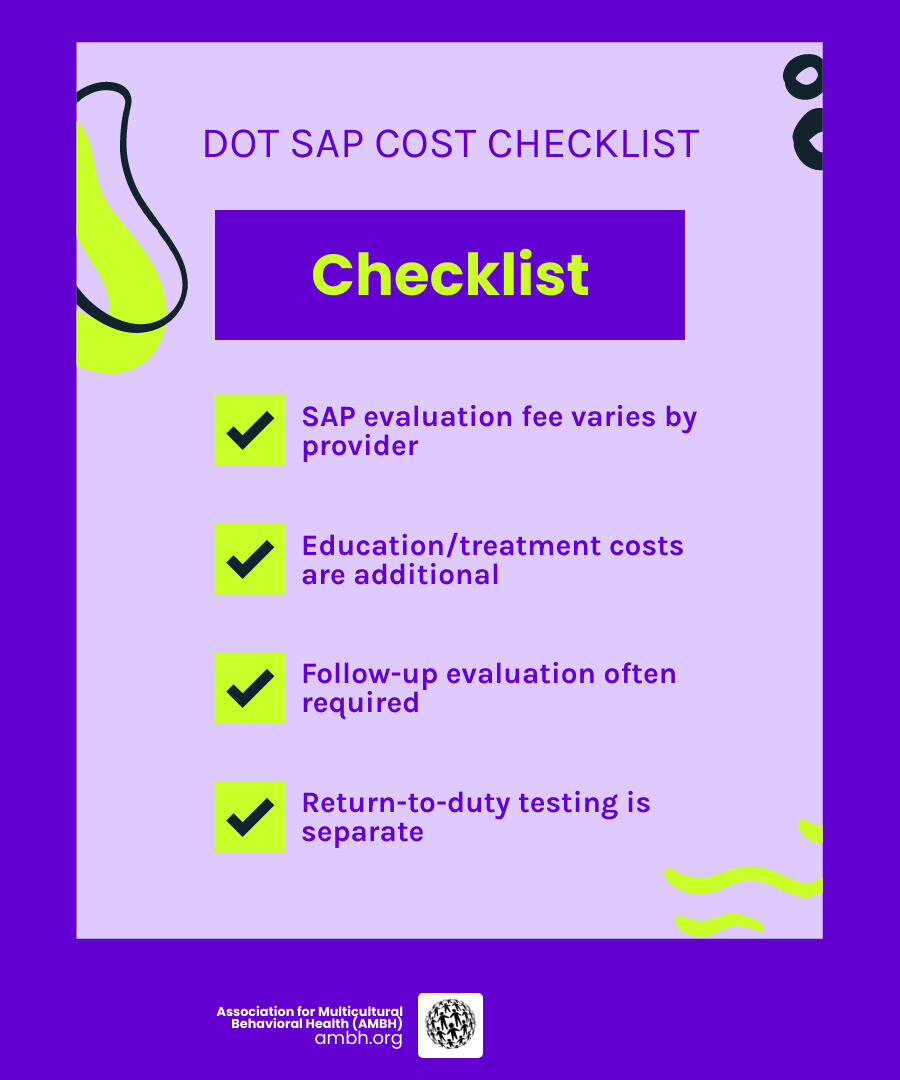
The total cost depends on more than the SAP evaluation. Commercial drivers may also need to pay for recommended education or treatment, a follow-up evaluation, and return-to-duty or follow-up testing. Ask what the evaluation fee includes, whether your employer covers any costs, and which services will be billed separately. AMBH’s complete SAP service is a flat fee of $550 (details below). With questions, please contact us.
Navigating a Department of Transportation (DOT) drug or alcohol violation can feel overwhelming, especially when you are trying to understand the financial investment needed to regain your eligibility to drive. Under federal safety rules outlined in 49 CFR Part 40, commercial drivers who test positive or refuse a test must complete a structured return-to-duty process with a qualified Substance Abuse Professional (SAP).
Understanding what drives these costs will help you plan your next steps clearly and without surprises.
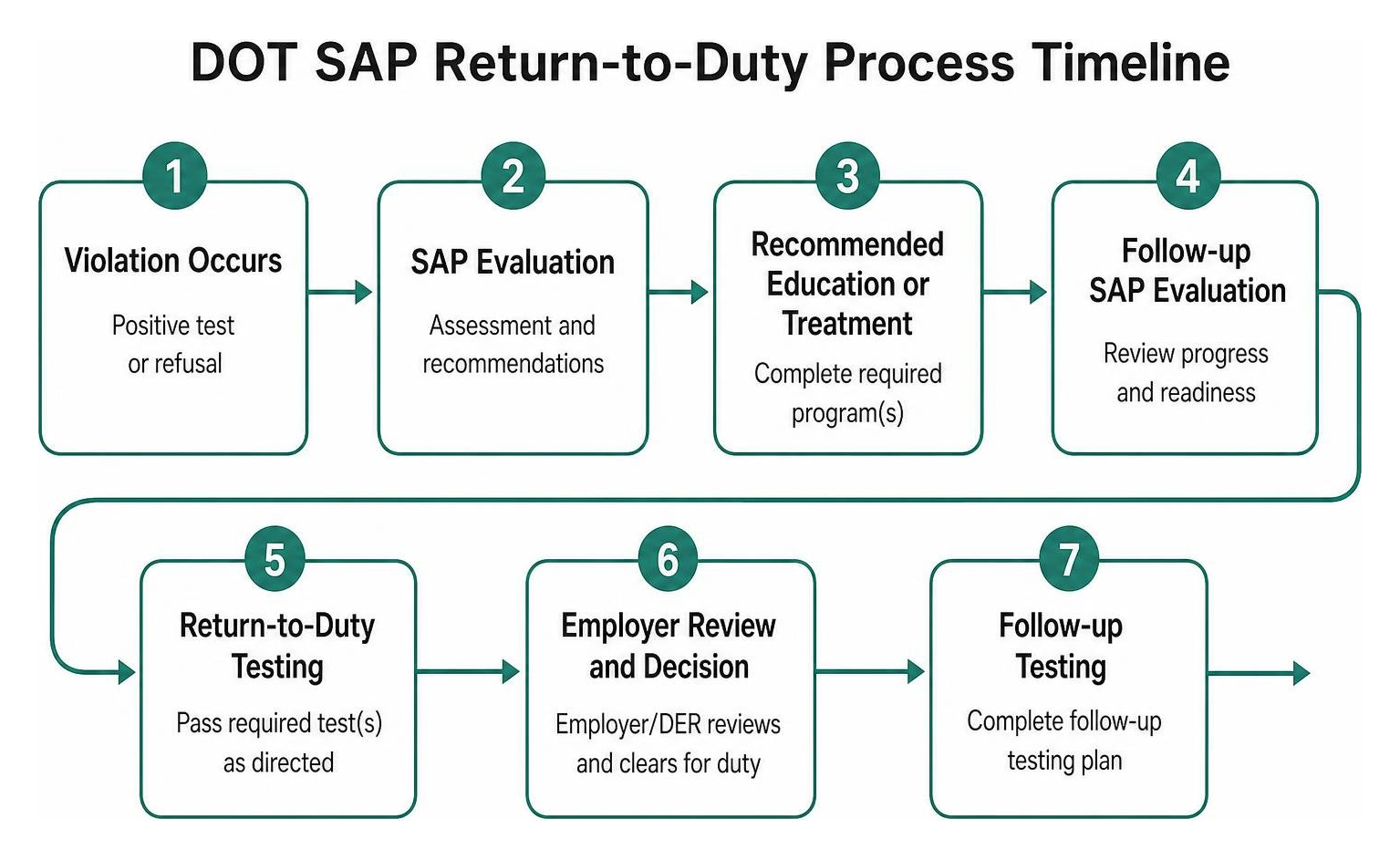
Total Breakdown of the Cost of DOT SAP Program Services

The overall financial commitment of completing a DOT return-to-duty plan is made up of several distinct components. Because federal guidelines under 49 CFR Part 40 strictly regulate how evaluations, education, and testing are handled, no two driver journeys are identical. Your total out-of-pocket expenses depend on the specific level of care recommended by your clinician, the testing procedures required by your employer or Designated Employer Representative (DER), and mandatory reporting inside the FMCSA Clearinghouse.
When budgeting for the process, commercial drivers should consider four primary cost centers:
- Initial Clinical Evaluation: The comprehensive face-to-face or authorized secure telehealth assessment conducted by a qualified SAP.
- Prescribed Education or Treatment: The specific educational classes or outpatient counseling sessions determined during your initial evaluation.
- Follow-Up Clinical Evaluation: The secondary assessment where your SAP determines whether you have successfully complied with the initial recommendations.
- Mandatory Testing Fees: The directly observed return-to-duty drug and alcohol screens, as well as subsequent unannounced follow-up tests ordered by your employer.
Federal regulations state that employers are not legally required to pay for these evaluations or treatment programs, although some company policies or collective bargaining agreements provide full or partial assistance. To get a clear view of standard clinical expenses, commercial drivers can review the evaluation, treatment, and compliance cost factors outlined below. AMBH’s complete SAP service is a flat fee of $550.
Initial and Follow-Up Evaluations: Core Cost of DOT SAP Program Requirements
The foundational expense of your compliance journey begins with the initial assessment and concludes with the follow-up evaluation. During the initial clinical interview, your SAP verifies your background, evaluates the circumstances surrounding the DOT violation, and designs an individualized plan consisting of either education or treatment.
Federal regulations under 49 CFR Part 40 require written documentation at multiple stages:
- An initial evaluation report with the required course of action, provided to your Designated Employer Representative (DER). The SAP enters the required dates for each stage of the process into the FMCSA Clearinghouse; the full report and treatment plan are not uploaded there.
- A formal follow-up evaluation report outlining your compliance status before you can be considered for return-to-duty testing.
Many providers bundle the initial assessment, the formal follow-up interview, and the required regulatory reporting into a single evaluation package. Others charge separate fees for each meeting. Our SAP service costs $550 and includes the initial evaluation, clinical assessment and testing, recommendations for education and/or treatment, a follow-up evaluation, development of the follow-up testing plan, communication with the Designated Employer Representative (DER), preparation of the required SAP reports, and entry of the required SAP information into the FMCSA Clearinghouse.
Education and Outpatient Treatment: Variable Cost of DOT SAP Program Options
The most variable element of your total expenses is the level of care mandated by the SAP. Under federal rules, an evaluator cannot simply clear a driver without prescribing a specific educational course or clinical intervention.
Depending on clinical criteria, recommendations fall into two primary paths:
- Substance Education Programs: For drivers with a first-time violation or low clinical risk, the SAP may assign an informational drug and alcohol awareness course. These structured programs are generally short-term and represent the lowest out-of-pocket expense.
- Outpatient Clinical Counseling: When clinical evaluation reveals a deeper pattern of substance use, structured outpatient care is required. This may include individual counseling, group therapy, and regular clinical monitoring.
For drivers whose SAP evaluation was completed by another SAP provider, AMBH provides dedicated outpatient substance abuse and addiction treatment delivered by experienced clinicians, allowing drivers to meet their clinical requirements while managing their personal schedules.
Comparing DOT SAP Process Costs and Service Options
Understanding how different components compare can help you evaluate service options effectively. Below is an overview of how out-of-pocket expenses are typically structured across the industry.
| Program Component | Standard Service Description | Typical Payment & Billing Factors |
|---|---|---|
| SAP Evaluation Package | Initial assessment, compliance monitoring, Clearinghouse updates, and follow-up evaluation | AMBH: flat fee of $550 for the complete SAP service |
| Education Programs | Structured drug and alcohol education (classroom or online), as recommended by the SAP | Billed directly by approved educational providers; varies by provider |
| Outpatient Therapy | Individual counseling, weekly group therapy, or specialized psychoeducation | Individual sessions start at $150; groups are $45/hr |
| Return-to-Duty Testing | Directly observed laboratory drug/alcohol screening ordered by employer/DER | Paid by driver or employer depending on company policy |
| Follow-Up Testing Schedule | Minimum of 6 unannounced observed tests over 12 months (up to 5 years) | Billed per collection and lab analysis across the testing schedule |
We offer SAP services in English, Polish, Russian, and Spanish.
Key Factors That Influence Your Total Expenses
Several operational and clinical variables influence the total cost of dot sap program completion:
- Level of Recommended Care: A short education course usually costs less than a longer course of outpatient counseling.
- Health Insurance Coverage for Clinical Care: While health insurance plans almost never cover specialized administrative SAP evaluation fees or Clearinghouse reporting, many major insurance policies do cover outpatient clinical therapy. AMBH accepts BCBS, Aetna, Cigna, Humana, UnitedHealthcare/Optum, Medicare (including Advantage PPO), and TRICARE (we do not accept Medicaid).
- Directly Observed Testing Requirements: All DOT return-to-duty and follow-up drug screens must be conducted under direct observation. Lab processing fees, collection site charges, and Medical Review Officer (MRO) review fees add to the recurring expense.
- Follow-Up Testing Frequency: The SAP is required by 49 CFR Part 40 to mandate a minimum of 6 unannounced follow-up tests within the first 12 months following return to safety-sensitive duty. The SAP may extend this testing schedule for up to 60 months, which increases long-term compliance expenses.
- Attendance and Compliance: Missing scheduled clinical sessions, failing to submit coursework on time, or arriving late for evaluation appointments can lead to cancellation fees or require repeating parts of the evaluation process.
Frequently Asked Questions About DOT SAP Program Costs
Who is responsible for paying for the DOT SAP process?
Under federal guidelines established by the FMCSA and the Department of Transportation, the employer is not legally obligated to pay for the employee’s SAP evaluation, prescribed education, treatment, or return-to-duty drug screens. In many situations, the financial responsibility rests entirely with the commercial driver. However, some companies choose to cover these expenses as part of their employee assistance programs (EAP), or their payment terms may be defined within union collective bargaining agreements. Always consult your human resources department or company DER to clarify your employer’s specific policy.
Does insurance cover the cost of a DOT SAP evaluation?
In almost all cases, commercial health insurance does not cover the SAP evaluation itself. Insurance carriers classify SAP assessments, employer compliance documentation, and FMCSA Clearinghouse management as specialized administrative and regulatory services rather than medically necessary health treatments. However, if your SAP recommends structured outpatient counseling or group therapy sessions, those specific clinical sessions may be eligible for health insurance coverage. AMBH accepts many major commercial plans (such as BCBS, Aetna, Cigna, Humana, and UnitedHealthcare), which can help offset clinical therapy expenses.
How can commercial drivers minimize their total out-of-pocket costs?
Commercial drivers can keep expenses manageable by maintaining strict compliance with every step of the process. You can reduce your overall costs by:
- Attending all scheduled initial and follow-up evaluation appointments promptly to avoid missed-appointment or rescheduling fees.
- Actively completing all educational modules or outpatient counseling assignments without delay, avoiding extended monitoring periods.
- Clarifying with your testing facility and employer upfront who is responsible for specific lab collection and MRO fees.
- Choosing a SAP provider with one clear fee that covers every required step of the SAP process.
Conclusion
Completing a DOT return-to-duty plan requires dedication, honest engagement, and a clear understanding of the financial and clinical steps involved. At the Association for Multicultural Behavioral Health (AMBH), our qualified clinicians provide outpatient behavioral healthcare and structured SAP services fully compliant with 49 CFR Part 40 regulations.
Whether you need initial evaluations, required follow-up assessments, or supportive outpatient counseling, our multicultural and multilingual team is here to support you with professional, non-stigmatizing care. We serve commercial drivers in person at our Edison Park office in Chicago (6650 N. Northwest Highway, Suite 215) as well as through secure telehealth for clients located throughout Illinois.
To discuss our comprehensive SAP services for DOT or to schedule your initial consultation, please contact us online or call our office directly at (773) 313-3757.